Introduction: Why Google Analytics 4 Is More Than Just a Tracking Tool
Most marketers treat analytics as a rearview mirror — something you check after the campaign is over to count clicks and sessions. But Google Analytics 4 (GA4) was built for something far more powerful. GA4 doesn’t just show you numbers. It reveals behavior, pathways, and predictive insights that can transform how you understand your audience and grow your business.
Whether you are running paid ads, building content funnels, or scaling an e-commerce store, GA4 gives you the intelligence to make smarter, faster, and more profitable decisions. In this article, we break down the full GA4 strategy framework — from tag setup to predictive audiences — so you can build what many top marketers call a predictable growth engine.
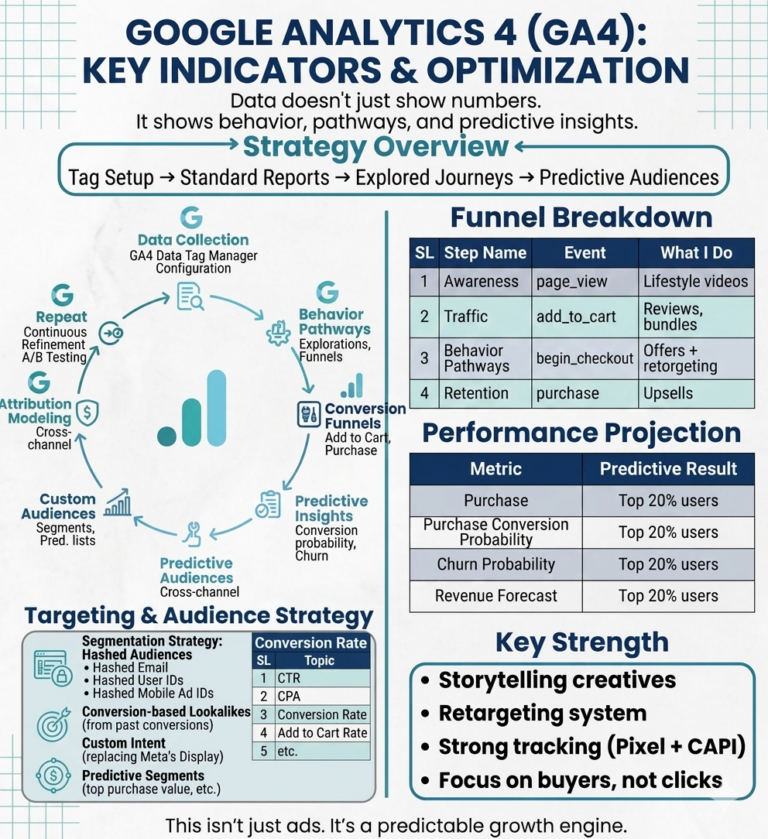
The GA4 Strategy Overview: A Four-Stage Framework
The foundation of any effective GA4 implementation follows a clear strategic path:
Tag Setup → Standard Reports → Explored Journeys → Predictive Audiences
Each stage builds on the previous one. Without a solid tag setup, your data is unreliable. Without explored journeys, you are guessing at user behavior. And without predictive audiences, you are leaving serious revenue on the table. Let’s walk through the full cycle.
Stage 1: Data Collection — Setting Up the Right Foundation
The journey begins with GA4 Data Tag Manager Configuration. This is the technical backbone of your entire analytics strategy. Google Tag Manager (GTM) serves as the deployment layer that connects your website’s actions — button clicks, form submissions, page views, purchases — to GA4’s event-based tracking system.
Getting this right matters enormously. Unlike the old Universal Analytics model that relied heavily on pageviews and sessions, GA4 tracks events as the primary unit of measurement. Every interaction a user has with your site or app can be captured, labeled, and analyzed. This shift is what gives GA4 its predictive power.
A proper tag setup includes configuring enhanced measurement events automatically (like scroll depth and outbound clicks), creating custom events for business-specific actions, and verifying data accuracy using GA4’s DebugView before going live.
Stage 2: Behavior Pathways — Understanding How Users Actually Move
Once data is flowing, the next step is mapping Behavior Pathways using GA4’s Explorations and Funnel reports. This is where GA4 starts to separate itself from older analytics platforms.
GA4’s Explorations tool gives you access to advanced analysis techniques like funnel exploration, path exploration, and cohort analysis. These tools let you answer questions that standard reports cannot — questions like “Where are users dropping off before checkout?”, “Which traffic source produces users who return the most?”, and “What sequence of actions leads to the highest purchase rate?”
Understanding these pathways transforms how you think about your marketing. Instead of optimizing for traffic volume, you start optimizing for the behavior patterns that lead to revenue.
Stage 3: Conversion Funnels — Tracking the Actions That Matter
The heart of any GA4 strategy is the Conversion Funnel — the sequence of events that moves a user from stranger to customer. The GA4 funnel breakdown in this framework covers four essential stages:
Funnel Breakdown Table
Step 1 — Awareness (page_view)
At the top of the funnel, the goal is visibility. The primary event tracked here is page_view, and the corresponding marketing activity involves lifestyle videos — content designed to introduce your brand to cold audiences. This is where you plant the seed.
Step 2 — Traffic (add_to_cart)
The second step tracks the add_to_cart event, signaling genuine purchase intent. The strategy here shifts to reviews and bundles — content that validates the decision to buy and adds perceived value. A user who adds to cart but doesn’t purchase is your most valuable retargeting audience.
Step 3 — Behavior Pathways (begin_checkout)
When a user fires the begin_checkout event, they are one decision away from converting. At this stage, the recommended approach is offers and retargeting — whether through Google Ads, Meta, or email sequences. This is where personalized messaging pays off the most.
Step 4 — Retention (purchase)
The final funnel stage tracks the purchase event, but the strategy doesn’t stop there. Post-purchase behavior is tracked to deploy upsells, turning one-time buyers into repeat customers and increasing lifetime value (LTV).
This four-stage funnel is not just a reporting structure — it is an action framework. Each event maps directly to a marketing move.
Stage 4: Predictive Insights — Where GA4 Gets Truly Powerful
One of GA4’s most underutilized features is its Predictive Insights capability. Using machine learning, GA4 can forecast user behavior before it happens, giving you a significant edge in campaign planning.
GA4 currently offers predictive metrics around Conversion Probability (the likelihood that a user will complete a purchase within the next 7 days) and Churn Probability (the likelihood that an active user will stop engaging). These aren’t guesses — they are model-driven scores based on actual behavioral patterns from your own audience data.
The business implication is massive: you can identify high-intent users before they buy and serve them a closing offer, or identify at-risk customers before they churn and intervene with a retention campaign.
Performance Projection: What GA4 Predicts for Top Users
The performance projection framework built around GA4’s predictive metrics focuses on top 20% of users across four key dimensions:
Purchase — GA4 identifies the users most likely to make a purchase, allowing you to concentrate your ad spend on the highest-probability converters rather than broad audiences.
Purchase Conversion Probability — This metric ranks users by how likely they are to buy, enabling smarter bidding strategies in Google Ads through audience signal integration.
Churn Probability — The flip side of conversion probability. Users with high churn scores need re-engagement campaigns before they disappear entirely. Catching them early is far cheaper than re-acquiring them later.
Revenue Forecast — GA4 projects future revenue contributions by user segment, allowing for more accurate budget planning and ROAS (Return on Ad Spend) forecasting.
The common thread across all four projections is a focus on the top 20% — a nod to the Pareto principle, which consistently shows that a small portion of users generate the majority of revenue.
Targeting & Audience Strategy: Building Smarter Segments
Great data is only valuable if you can act on it. GA4’s audience builder connects directly to Google Ads, enabling hyper-targeted campaigns powered by real behavioral data. The audience strategy in this framework operates across four layers:
Segmentation Strategy: Hashed Audiences — For privacy-compliant targeting, GA4 supports audience creation based on hashed email addresses, hashed user IDs, and hashed mobile ad IDs. This allows you to match your CRM data with GA4 behavior data in a way that respects user privacy while maintaining targeting precision.
Conversion-Based Lookalikes — By building lookalike audiences from past converters, you expand your reach to users who mirror the behavioral DNA of your best customers. This is especially powerful when your conversion data is rich and varied.
Custom Intent — GA4 audiences can replace traditional Meta Display targeting by using actual on-site behavior (not just interest categories) to define who sees your ads. Users who viewed specific product pages, spent more than 2 minutes on your site, or visited 5+ pages in a session are far more qualified than a generic interest group.
Predictive Segments — Perhaps the most advanced layer, predictive segments group users by top purchase probability, high churn risk, or projected revenue contribution. These segments feed directly into Google Ads smart bidding for automated, performance-driven targeting.
Attribution Modeling: Seeing the Full Customer Journey
GA4 includes cross-channel attribution modeling, which is essential for understanding which marketing touchpoints actually drive conversions. This moves you beyond last-click attribution (which over-credits the final interaction and under-credits everything before it) to a more holistic view.
GA4’s data-driven attribution model uses machine learning to distribute credit across all the touchpoints in a conversion path — whether that’s a YouTube ad, an organic search, a retargeting display ad, or a direct visit. Understanding this helps you allocate budget more accurately and avoid cutting channels that are doing important work earlier in the funnel.
The Continuous Refinement Loop: Repeat, Test, Improve
The GA4 strategy cycle doesn’t end with a campaign launch. The final and ongoing stage is Continuous Refinement through A/B Testing. GA4’s integration with Google Optimize (and third-party testing tools) allows you to run experiments on landing pages, ad creatives, email subject lines, and checkout flows — then measure the impact directly in your analytics dashboard.
This creates a self-improving loop: data informs strategy, strategy drives action, action generates new data. Over time, this compounding cycle is what separates businesses that grow predictably from those that rely on luck.
Key Strengths of This GA4 Framework
The real-world advantages of implementing this full GA4 strategy can be summarized in four pillars:
Storytelling Creatives — Every campaign starts with content that speaks to a specific stage of the funnel. Awareness content tells a story, traffic content builds trust, and conversion content closes the deal. GA4 data tells you which stories are resonating and which aren’t.
Retargeting System — With GA4-powered audience lists feeding into Google Ads and Meta campaigns, you maintain a persistent, behavior-based retargeting system that follows users through their decision journey without being intrusive.
Strong Tracking (Pixel + CAPI) — Combining GA4 event tracking with Meta’s Conversions API (CAPI) creates a dual-layer tracking system that survives iOS privacy restrictions and browser-based ad blockers. Your data remains complete and actionable even in a privacy-first world.
Focus on Buyers, Not Clicks — The most important mindset shift this framework enables is moving from vanity metrics (impressions, clicks, CTR) to buyer metrics (conversion probability, revenue forecast, LTV). This is what makes GA4 a growth engine rather than a reporting tool.
Conversion Rate Optimization Topics to Track in GA4
Beyond the funnel, there are five conversion-related topics that should be regularly monitored and tested within your GA4 dashboard:
CTR (Click-Through Rate) — Tracks which ad creatives, headlines, and CTAs are compelling users to engage. A low CTR at the awareness stage signals a messaging problem, not a targeting problem.
CPA (Cost Per Acquisition) — Measures the efficiency of your spend. GA4’s integration with Google Ads makes it easy to see CPA by traffic source, device, audience segment, and campaign.
Conversion Rate — The percentage of sessions that result in a defined goal completion. GA4 lets you track multiple conversion events simultaneously, giving you a richer picture of overall funnel health.
Add to Cart Rate — A critical mid-funnel indicator. A high add-to-cart rate with a low purchase rate points to checkout friction — shipping costs, payment options, or trust signals that need addressing.
Etc. (Custom Metrics) — GA4’s flexibility allows you to define and track any business-specific metric that matters to your goals, from video completion rates to scroll depth on key landing pages.
Conclusion: GA4 Is a Predictable Growth Engine
Google Analytics 4 is not just an upgrade from Universal Analytics — it is a fundamentally different philosophy of measurement. When implemented with the full strategy cycle described above (Data Collection → Behavior Pathways → Conversion Funnels → Predictive Insights → Custom Audiences → Attribution → Refinement), GA4 becomes the central nervous system of your entire digital marketing operation.
This isn’t just ads. It’s a predictable growth engine — one that gets smarter with every campaign, every click, and every conversion.
If you are ready to implement this framework for your business, start with a clean GA4 tag setup, map your core conversion funnel, and build your first predictive audience. The data you collect today is the competitive advantage you will activate tomorrow.