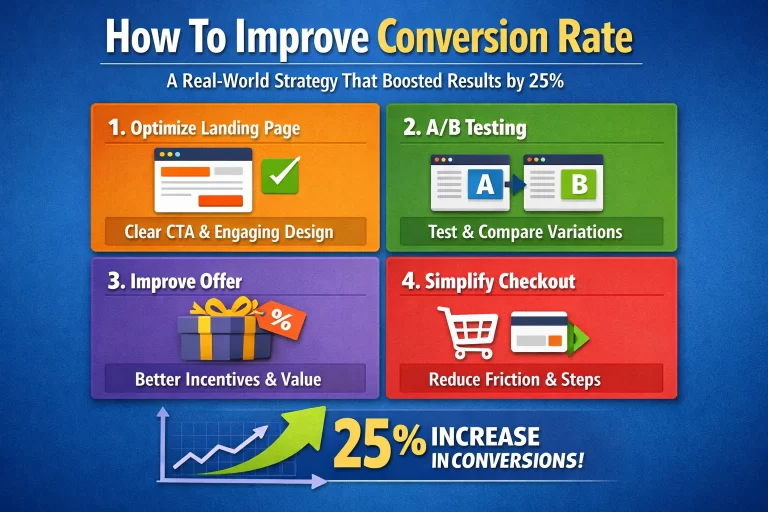
Introduction: More Traffic Isn’t Always the Answer
If you’re running paid campaigns or investing in SEO, you’ve probably faced this frustration: your landing pages are getting traffic — but your conversions just aren’t keeping up.
The instinct is to spend more. More ads, more reach, more clicks.
But what if the real problem isn’t how many people are arriving — it’s what’s happening after they land?
At InDeeLeads, we experienced this exact scenario. Our landing pages were pulling in traffic, but conversion rates were stuck at around 4% — limiting the ROI of every campaign we ran. Instead of increasing our ad spend, we chose a smarter path: fix what was already broken.
This article walks you through the exact STAR framework we used — Situation, Task, Action, Result — so you can apply the same methodology to your own funnels and finally answer the question: how do you improve conversion rate without burning your budget?
S — Situation: Traffic Without Conversions Is Just Noise
Our campaigns were live. Clicks were coming in. Analytics showed healthy traffic volumes across multiple landing pages.
But the numbers that mattered told a different story:
- Conversion rate: ~4%
- Cost per lead: higher than sustainable
- Campaign ROI: underwhelming
This is one of the most common — and most expensive — problems in digital marketing. A 4% conversion rate means 96 out of every 100 visitors are leaving without taking action. Even if your traffic is perfectly targeted, that kind of leakage will kill your margins.
The hard truth? Most businesses in this position pour more money into acquisition. They increase ad budgets, test new audiences, and expand their reach — while the hole in their funnel quietly drains every rupee.
We decided to stop filling the bucket and start patching the holes.
T — Task: Improve Conversion Rate Without Increasing Traffic Spend
Our goal was clear: increase the conversion rate without significantly raising our cost per click or expanding our traffic budget.
This meant shifting focus entirely to Conversion Rate Optimization (CRO) — a discipline built around improving the percentage of visitors who complete a desired action, whether that’s filling out a form, booking a call, or making a purchase.
CRO doesn’t just make your funnel more efficient. It multiplies the value of every visitor you’ve already paid for. Even a 1 percentage point improvement can dramatically reduce your cost per lead and improve overall campaign profitability.
With that task defined, we got to work.
A — Actions: The 5-Step CRO Process We Followed
1. Analyzed User Behavior Using Heatmaps and Analytics
Before we could fix anything, we needed to understand what was actually happening on our pages.
We used a combination of:
- Heatmaps (click maps, scroll maps, and move maps) to see where users were engaging and where they were ignoring elements entirely
- Session recordings to watch real user behavior and identify points of confusion
- Google Analytics / funnel analysis to understand where users were dropping off in multi-step flows
This phase is non-negotiable. Guessing at CRO problems is expensive and unreliable. Data tells you exactly where users are struggling — and that’s where you focus your energy first.
What we found: Users were scrolling past our primary CTAs, hesitating at form fields, and abandoning pages before reaching the value proposition. The data gave us a clear roadmap.
2. Identified Drop-Off Points in Forms and Page Flow
One of the biggest conversion killers we uncovered? Our forms.
Long, complex forms create friction. Every additional field you ask a visitor to fill out is another reason for them to abandon the page. We audited every form on every landing page and asked:
- Does every field serve a conversion purpose?
- Are we asking for information we don’t strictly need at this stage?
- Is the form visually intimidating before users even start?
- Are there error messages that confuse or frustrate users?
We also mapped the full page flow — from headline to CTA — and identified where the logical progression broke down. In several cases, we found that value statements came after the CTA, meaning users were being asked to convert before they understood why they should.
3. Simplified Forms and Improved CTA Placement
Armed with our audit findings, we made targeted changes:
Form simplification:
- Reduced fields to the minimum required (name, email, phone — nothing more at the top of funnel)
- Used inline validation to reduce form errors
- Added trust signals (privacy assurance text) directly below form submit buttons
CTA optimization:
- Moved primary CTAs above the fold on all high-traffic pages
- Replaced vague CTA copy like “Submit” or “Click Here” with specific, benefit-driven copy like “Get My Free Quote” or “Start Saving Today”
- Added secondary CTAs lower on the page for users who needed more information before deciding
The placement and language of your CTA is arguably the single most impactful on-page factor for conversion. A CTA buried at the bottom of a long page, using generic copy, will underperform every single time.
4. Optimized Page Speed and Mobile Responsiveness
Here’s a CRO issue that many marketers overlook: slow pages kill conversions.
Research consistently shows that even a one-second delay in page load time can reduce conversions significantly. For mobile users — who represent the majority of traffic for most lead gen campaigns — a poor experience is an immediate exit.
We addressed this by:
- Compressing and lazy-loading images
- Removing unnecessary JavaScript and third-party scripts
- Leveraging browser caching and a CDN
- Auditing all landing pages on mobile devices across multiple screen sizes
- Fixing tap target sizes, font readability, and form usability on mobile
If your page doesn’t load fast and look clean on a phone, you’re losing leads — period.
5. Ran A/B Tests on Headlines, Creatives, and Layout
Once we’d fixed the obvious issues, we shifted to testing.
A/B testing allows you to pit two versions of a page element against each other to see which performs better. Rather than guessing what resonates with your audience, you let the data decide.
We tested:
- Headlines — different value propositions, urgency cues, and specificity levels
- Hero images and creatives — lifestyle imagery vs. product-focused vs. social proof
- Page layouts — single-column vs. two-column, form position, section ordering
- CTA button colors and copy — contrasting colors vs. brand colors, verb-forward copy vs. benefit-forward copy
- Social proof placement — testimonials above the fold vs. near the CTA
We ran each test long enough to achieve statistical significance before making any decisions. Rushed A/B tests lead to false conclusions and wasted effort.
The result? Several clear winners across our page elements — and a systematic, evidence-based approach to optimization that we could continue applying over time.
R — Results: What Happened When We Fixed the Funnel
The impact of these changes was measurable and meaningful:
| Metric | Before Optimization | After Optimization |
|---|---|---|
| Conversion Rate | ~4% | 5%+ |
| Improvement | — | ~25% increase |
| Cost Per Lead | Higher | Significantly reduced |
| Funnel Efficiency | Leaky | Streamlined |
Key Outcomes:
✅ Conversion rate increased from ~4% to 5%+ — a ~25% relative improvement. That might sound modest, but on a volume campaign, it represents a significant number of additional leads generated from the same traffic.
✅ Reduced cost per lead significantly — because more of our existing traffic converted, we needed less spend to hit lead volume targets.
✅ Improved overall funnel efficiency — the entire system, from ad click to form submission, became tighter. Less waste, more output.
The most important takeaway: we achieved all of this without increasing our traffic spend. The budget stayed the same. The results improved. That’s the power of CRO done right.
Bonus: Key Principles for Sustainable Conversion Rate Improvement
If you want to improve conversion rate consistently over time — not just as a one-time fix — here are the principles that should guide your approach:
Always Start With Data, Not Assumptions
Before changing anything on your page, instrument it properly. Heatmaps, session recordings, and funnel analytics are your foundation. Data-driven CRO outperforms gut-instinct CRO every time.
Reduce Friction at Every Step
Every click, field, scroll, or decision you ask of a user is friction. Your job is to remove as much as possible without compromising the quality of the lead or the clarity of the offer.
Make Your Value Proposition Unmissable
Users decide within seconds whether a page is worth their attention. Your headline, subheadline, and hero section must answer: What is this? Why should I care? What do I do next?
Test Continuously — There Is No Finish Line
CRO is not a project you complete. It’s an ongoing practice. Markets change, audiences evolve, competitors improve. The teams that win in performance marketing are the ones who never stop testing.
Align Your Ads and Landing Pages
Conversion rate problems often originate before the landing page — in the ad itself. If your ad promises one thing and your landing page delivers another, users will bounce immediately. Message match between ad and page is essential.
Conclusion: Stop Buying More Traffic — Start Converting More of It
The answer to “how to improve conversion rate” isn’t complicated — but it does require discipline, data, and a willingness to test and iterate.
At InDeeLeads, we took a systematic approach: we analyzed behavior, identified friction, simplified the experience, optimized for speed and mobile, and tested relentlessly. The result was a 25% improvement in conversion rate and meaningfully better economics across our campaigns.
You don’t need a bigger budget to get better results. You need a better funnel.
Start with your data. Fix your friction. Test everything. And watch your leads grow — without spending a rupee more on traffic.
Ready to improve your own conversion rates? Explore more CRO strategies and lead generation insights at InDeeLeads.com.