Every SEO conversation eventually comes back to two things — content and backlinks.
But there’s a third lever that most marketers consistently underuse: internal linking.
Some SEOs swear by backlinks as the ultimate authority signal. Others call internal linking the most overlooked growth tool in SEO today.
So who’s right?
Both, actually. They just do different jobs.
What Are Backlinks?
A backlink is a link from an external website pointing to yours.
Google treats these as trust signals — essentially votes from other sites saying your content is worth reading. The more authoritative those sites are, the stronger the signal.
Backlinks help you:
- Build domain authority to compete for harder keywords
- Improve rankings in competitive niches
- Get pages discovered and indexed faster
- Establish credibility in your space
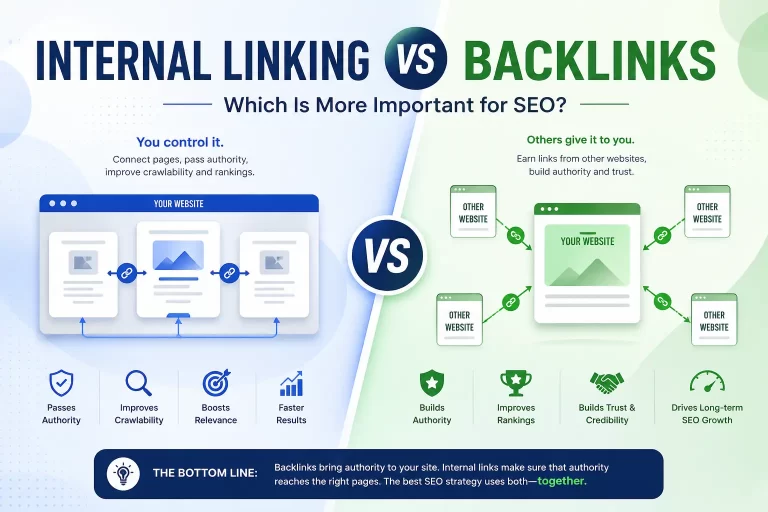
A simple way to think about it: backlinks bring authority into your site. Without them, even great content struggles to rank in competitive verticals like finance, SaaS, travel, or affiliate SEO.
What Is Internal Linking?
Internal links connect pages within the same website — a blog post linking to a service page, a pillar guide linking to cluster articles, a category page pointing to products.
Simple idea. Bigger impact than most people realise.
Here’s what internal linking actually does for SEO:
1. Distributes Authority Across Your Site A blog post with strong backlinks can pass link equity to your service pages, landing pages, or product pages — improving their rankings without a single new external link.
2. Builds Topical Authority Google increasingly rewards depth of expertise, not just isolated keywords. When your pillar page links to supporting cluster pages — and they link back — search engines map your subject matter coverage clearly. That topical structure builds relevance and trust.
3. Improves Crawlability Poor internal linking creates orphan pages, crawl gaps, and important pages buried too deep in your site. Good internal architecture keeps search engines moving efficiently through your content.
4. Signals Relevance Through Anchor Text “Click here” tells Google nothing. “Meta Ads lead generation strategy” tells Google exactly what the linked page is about. Descriptive anchor text reinforces keyword relevance every time it appears in body content.
5. Delivers Quick Wins Unlike link building, internal linking is fast, cheap, fully in your control, and low-risk. Updating internal links alone has moved rankings without a single new backlink being built. That’s a rare kind of SEO leverage.
The Core Difference
Here’s the clearest way to separate them:
Backlinks bring authority in. Internal links direct where it goes.
Think of it like water and plumbing. Backlinks fill the reservoir. Internal links determine which pages actually get irrigated.
Without water, plumbing doesn’t do much. Without plumbing, water never reaches the right places.
You need both working together.
So Which One Is More Important?
If your domain lacks authority — backlinks matter more. No amount of smart internal linking will overcome a trust deficit in a competitive SERP.
If your domain already has authority — internal linking may deliver faster results. Many established sites are sitting on untapped ranking potential simply because their internal architecture is weak. An internal link audit often reveals more opportunity than a new link-building campaign.
Best Practices for Internal Linking
- Build topic clusters — pillar pages linking to supporting content, and cluster pages linking back
- Prioritise contextual links — links within body content carry more weight than footer or sidebar links
- Use descriptive anchor text — keyword-relevant, specific, natural
- Give your most important pages the most links — link frequency signals priority
- Fix orphan pages — if a page matters, it should be reachable via internal links
- Keep click depth shallow — important pages should be reachable within two or three clicks from the homepage
Can Internal Linking Replace Backlinks?
No.
Internal linking amplifies existing authority. It rarely creates authority where none exists. These are different functions, and confusing them leads to gaps in your strategy.
The Bottom Line
Backlinks are still the stronger universal ranking factor. But internal linking is almost certainly the most underrated high-ROI activity in SEO — because you control everything about it, and most sites are doing it poorly.
The smartest way to frame it:
- Content makes you relevant
- Backlinks make you trusted
- Internal links make you efficient
If your authority is weak, build links. If your authority is solid but rankings are stuck, audit your internal linking before anything else.
The opportunity is often already sitting inside your own site.
More Articles to read on SEO –